
Pull up three supplier storage guides for research peptide vials and you get three different protocols. Not three shades of the same protocol. Three different answers to the same question, all published this year, all written like the matter is settled.
That is a problem for anyone running work that depends on knowing what is in the vial.
This post walks through where the guidance splits, what the underlying literature actually establishes, and how to handle a storage claim when the sources disagree. Everything here is laboratory-focused. Research peptides are for research use only and are not for human or animal consumption.
Where The Guidance Splits?
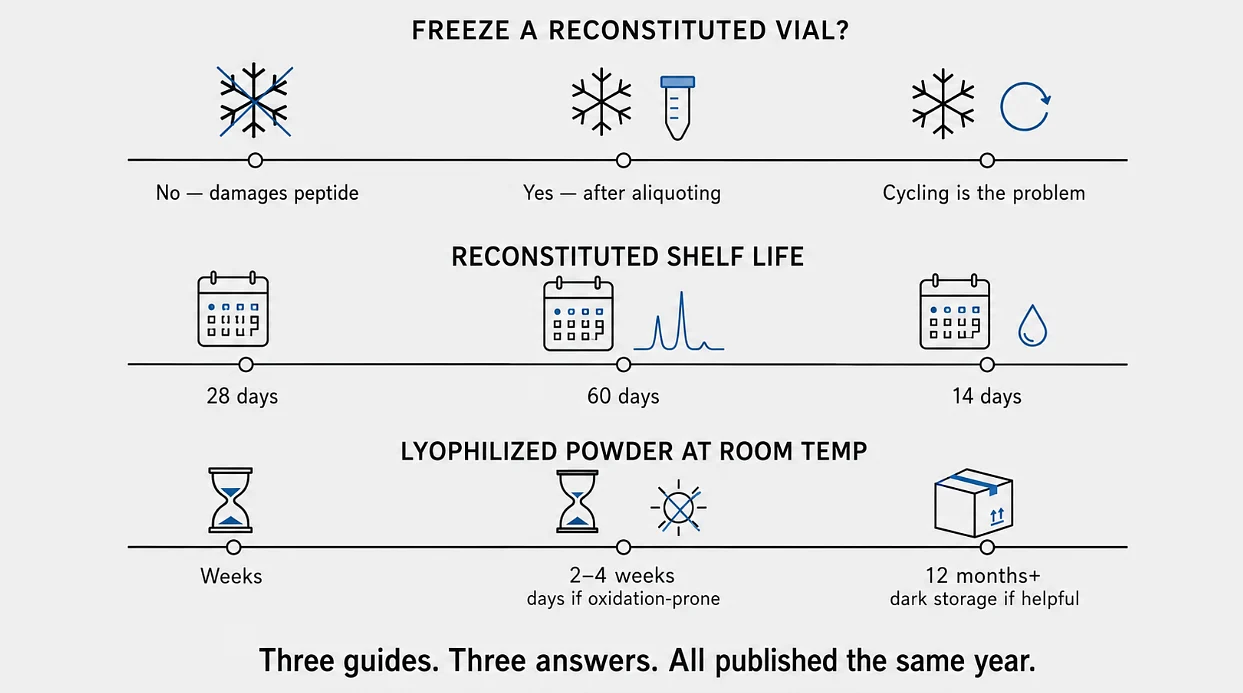
Three questions, and the published answers do not line up.
Can you freeze a reconstituted vial?
One 2026 guide says do not freeze a reconstituted vial at all, because the freeze-thaw cycle damages the peptide. Another says yes, freeze it, but only after aliquoting into single-use portions. A third says freezing itself is not the problem, the cycling is.
Those are not compatible. A researcher following the first one discards leftover solution. A researcher following the second one freezes it and keeps working.
How long does a reconstituted solution hold?
The 28 day figure shows up on most sites and gets treated as the standard. One guide argues that 2026 HPLC data pushes chemical integrity to around 60 days at 2-8°C. Another splits it by solvent, roughly four weeks with bacteriostatic water and one to two weeks with sterile water.
So 28 days, 60 days, or 14 days. Take your pick based on who you bought from.
How long does lyophilized powder hold at room temperature?
One says weeks. One says two to four weeks, but only days if the sequence carries oxidation-prone residues. One says 12 months or more in the dark for most sequences.
Weeks, days, or a year. Same product category, same year.
The Citation Problem Underneath It
The disagreement would be easier to sort out if the guidance pointed back to sources. Mostly it does not.
Some sites assert numbers with no citation at all. Some name an author and a year without the paper. One cites “Manning et al. (2010)” for freeze-thaw aggregation. Another cites “Manning, Patel and Borchardt 1989” for degradation pathways. Those are two different papers, and the second one is the canonical review the first one updates. Neither citation as written tells you which claim came from where.
One guide attaches a PMID to a freeze-thaw claim. That PMID does not match the Manning 2010 paper it appears to be describing. Small thing, but it is the kind of small thing that spreads. Once a number gets copied without the source attached, the next site copies the number and not the check.
The result is a field where storage advice reads as evidence-based and mostly is not.
What The Primary Literature Actually Establishes?
The real source material here is narrower than the guidance implies, and it is older.
Manning, Patel and Borchardt published the foundational review of protein pharmaceutical stability in Pharmaceutical Research in 1989. Manning and colleagues published the update in the same journal in 2010, and Pharmaceutical Research ran a further advances review in 2024. Those papers are where the degradation pathways come from.
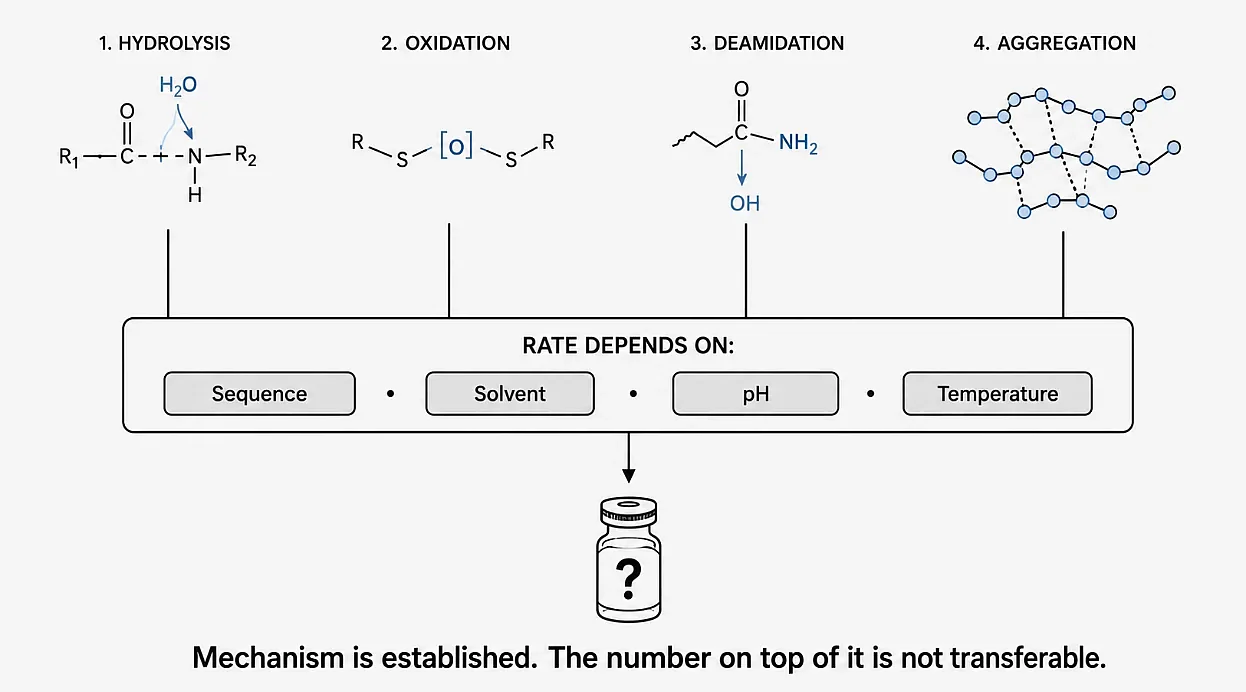
What they establish is mechanism, not a number for your vial:
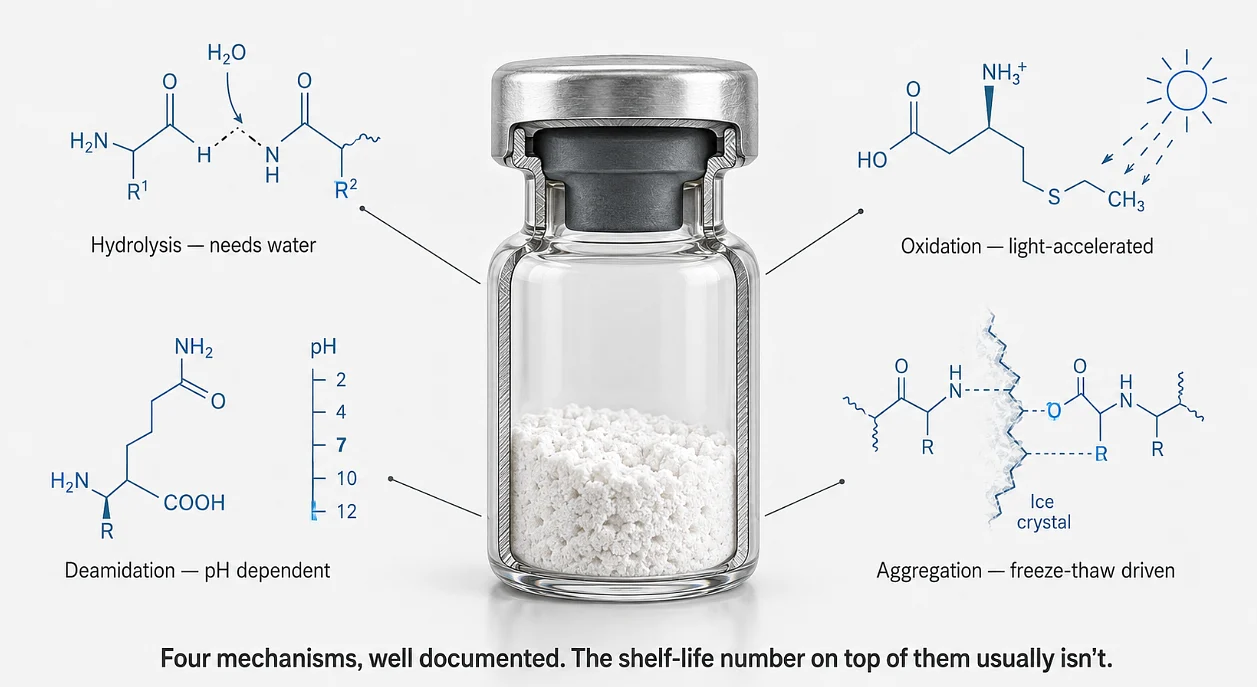
- Hydrolysis cleaves peptide bonds, and it needs water to run. Removing water is why lyophilization works.
- Oxidation targets methionine, tryptophan and cysteine residues. Sequences carrying those degrade faster, and light exposure accelerates it.
- Deamidation hits asparagine and glutamine, and the rate is strongly pH dependent.
- Aggregation is the physical one. Freeze-thaw cycling drives it because ice crystal formation concentrates the peptide at the ice-water interface and partially unfolds it.
Read that list and the contradictions start making sense. Every one of those pathways runs at a rate set by the specific sequence, the specific solvent, the specific pH, and the specific storage temperature. A peptide with no methionine and no asparagine behaves nothing like one carrying both.
So the guides are not all wrong. They are answering for different molecules and presenting the answer as general.
A shelf life number without a sequence attached is not telling you much.
Why The Vial Format Is What Makes This Workable?
This is the part where the format actually matters, and it is worth spelling out.
A pre-formulated product hands you someone else’s decisions. Their solvent, their concentration, their pH, their fill volume. If their stability data was generated on a different sequence than the one you are working with, you have no way to adjust.
A peptide vial hands you lyophilized powder and nothing else. You choose the solvent. You set the concentration by how much you add. You decide the aliquot size and how many single-use portions you split the batch into before anything goes in the freezer.
That control is the whole argument. The degradation pathways above are all rate problems, and most of the levers on those rates are handled at reconstitution. Solvent choice sets the pH. Aliquot size sets how many freeze-thaw cycles any given portion sees. Vial headspace affects oxygen exposure. None of those are available to you if the decisions were made upstream.
The reconstitution step gets treated as a chore in a lot of write-ups. It is the opposite. It is the point at which the researcher takes over the variables that determine how long the material holds.
How To Handle A Storage Claim When The Sources Disagree?
Practical version, since the literature is not going to hand you a number:
- Check the sequence before the shelf life. Look at whether the peptide carries methionine, tryptophan, cysteine, asparagine or glutamine. Those residues are where the fast degradation pathways run. A generic 28 day figure means something different for a sequence loaded with them.
- Treat batch documentation as the real answer. A certificate of analysis tied to your specific batch, with HPLC purity and mass spec identity, tells you what you started with. Generic storage guidance cannot. Suppliers like peptides.com publish batch-level analytical data and third-party testing across the vial catalog, and that documentation is what lets you establish a known starting point rather than an assumed one.
- Aliquot before the first freeze, every time. This one holds across every source, and the mechanism supports it. Freeze-thaw aggregation is well documented in the Manning reviews. Splitting the batch before it ever freezes removes the variable entirely, and it costs you a few sterile tubes.
- Let the vial reach room temperature before opening it. Cold glass pulls condensation out of the air, and that puts water back into the powder you paid to have removed.
- Re-analyze if the material has been sitting. HPLC is the only thing that tells you what is in the vial now. A clear solution can carry significant deamidated or oxidized species and look exactly like it did on day one.
The Part Worth Remembering
The storage guidance published across this category in 2026 does not agree with itself because most of it is generalizing from mechanism to a number without saying which sequence the number applies to. The mechanisms are solid and well documented. The numbers on top of them are not transferable.
Which means the useful habit is not memorizing a shelf life. It is knowing your sequence, keeping the batch documentation, aliquoting before the first freeze, and re-testing when it matters.
That is boring work. Genuinely boring. It is also the only version of this that survives contact with a disagreement in the literature.
This article covers laboratory handling of research peptide vials and is for educational purposes. All compounds referenced are for research use only and are not intended for human or animal consumption, or to diagnose, treat, cure, or prevent any disease.
References
Manning MC, Patel K, Borchardt RT – Stability of protein pharmaceuticals (Pharmaceutical Research, 1989;6:903-918)
- https://doi.org/10.1023/A:1015929109894
Manning MC, Chou DK, Murphy BM, Payne RW, Katayama DS – Stability of protein pharmaceuticals: an update (Pharmaceutical Research, 2010;27(4):544-575, PMID 20143256)
- https://pubmed.ncbi.nlm.nih.gov/20143256/
Stability of Protein Pharmaceuticals: Recent Advances (Pharmaceutical Research, 2024)
- https://link.springer.com/article/10.1007/s11095-024-03726-x
ICH Q1A(R2) – Stability Testing of New Drug Substances and Products (International Council for Harmonisation)
- https://www.ich.org/page/quality-guidelines
